
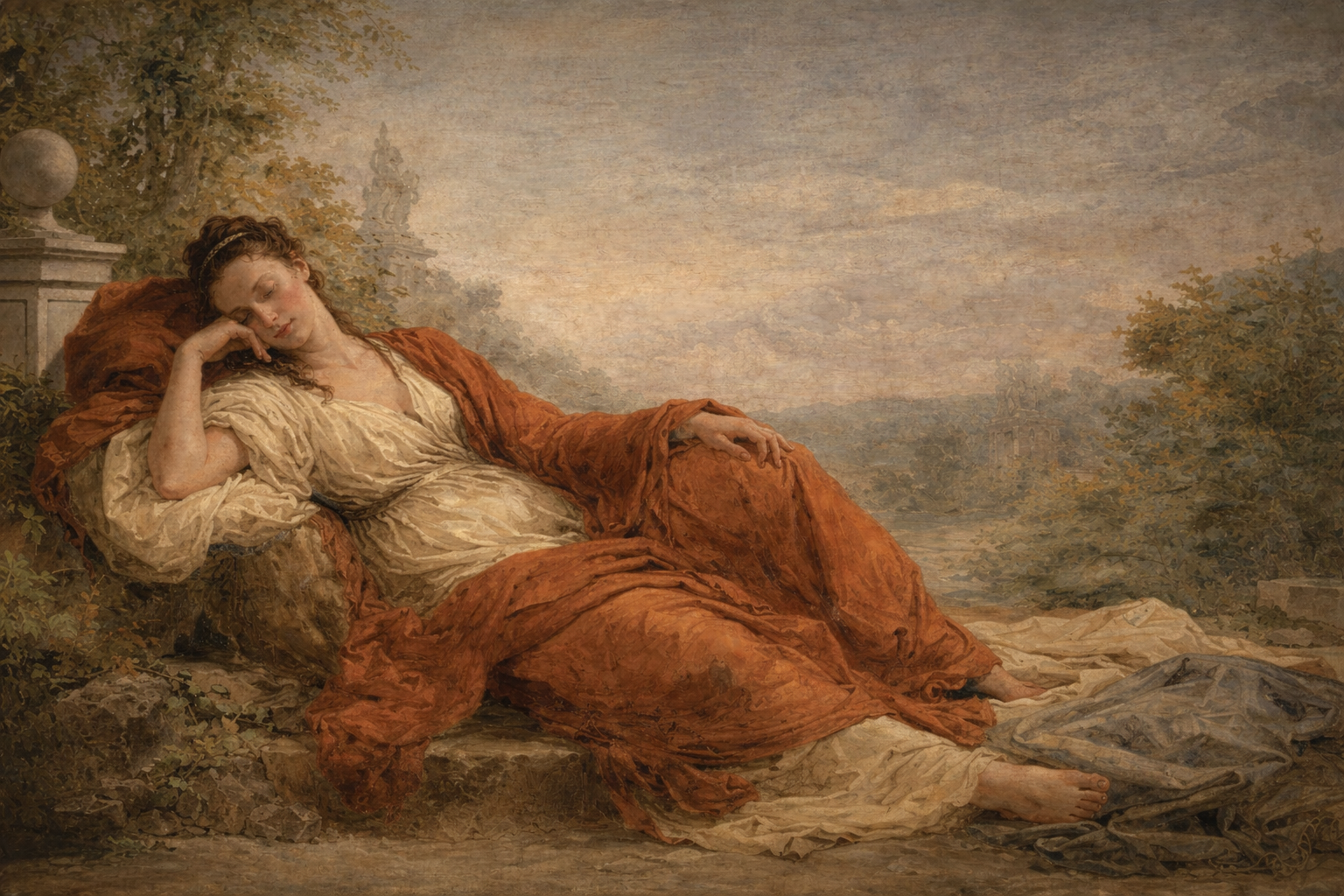
Curated on the Body
What we experience as effortless beauty is rarely accidental. Whether within the quiet halls of a museum or in the intimate act of getting dressed, what feels natural has almost always been carefully composed. There is a hidden architecture to experience—a choreography of movement, light, texture, and sequence—that shapes not only what we see, but how we feel, what we notice, and what we remember.
Fabric Echoes invites us to recognize that dressing, like exhibition design, has always been an orchestrated experience.
Before clothing became immediate and impulsive, it was curated. Not by institutions, but by culture itself. Each layer, each fabric, each silhouette was selected with awareness—of context, of occasion, of identity. To dress was to move through a narrative. There was a beginning, a progression, a presence, and an impression left behind. Nothing was random. Everything was placed.
And just as in a museum, the experience began long before the moment of encounter.
The curator’s role in exhibition design is to shape meaning through intention—to decide not only what is shown, but how it is revealed. In the world of textiles, this role once belonged to artisans, tailors, and wearers themselves. A garment was not simply created; it was positioned within a larger story. Was it ceremonial or functional? Personal or communal? Seasonal or symbolic? These decisions defined how it would be seen, understood, and remembered.
Today, much of this authorship has been surrendered.
We move quickly, choosing garments without considering their sequence, their relationship to one another, or the environment they enter. The rhythm has been lost. Yet rhythm is essential. Just as exhibitions guide visitors through moments of intensity and pause, what we wear has the ability to create a flow—an experience that unfolds throughout a day. There are garments that speak loudly, and others that allow silence. There are combinations that overwhelm, and others that create harmony.
To dress with awareness is to compose.
Lighting, in a gallery, is never neutral. It reveals, enhances, conceals. It directs attention without asking permission. In the same way, textiles respond to light in ways most people no longer consider. A fabric can absorb or reflect, soften or sharpen, warm or cool the presence of the body within it. Colors shift, textures emerge or disappear, depending on the environment. What we wear is constantly in dialogue with light, whether we notice it or not.
And still, we rarely notice.
Background, too, plays its role. In exhibition spaces, wall color and texture shape perception as much as the artwork itself. In life, the environments we move through—urban, natural, interior, social—interact continuously with what we wear. A garment that feels powerful in one setting may become diminished in another. Context is not secondary. It is integral.
Fabric Echoes brings this awareness forward
—not to complicate, but to deepen.
Because clothing does not exist in isolation. It exists in relationship. Between pieces, body and space, and between intention and perception.
When objects are placed in proximity, they begin to speak to one another. Museums understand this well. A single artwork may carry meaning, but placed beside another, it creates dialogue. The same is true in how we dress. Combinations are not merely aesthetic—they are communicative. They suggest contrast, continuity, tension, or unity. They create a visual language that others interpret, often unconsciously.
And yet, we have been taught to see outfits, not relationships.
Technology has expanded how exhibitions are experienced, adding layers of interpretation without replacing the original work. In textiles, innovation has followed a different path—often replacing rather than supporting. Materials engineered for efficiency have distanced us from the tactile, the breathable, the responsive. The experience of fabric has been flattened, simplified, reduced.
The human body still recognizes what is real.
It responds to weight, to movement, to temperature, to texture. It knows when something is aligned and when it is not. This is where true accessibility begins—not only in physical design, but in sensory understanding. Clothing should not require explanation to be felt correctly. It should communicate through experience.
Even language, in exhibition design, is carefully measured. Too much information overwhelms. Too little leaves confusion. The same balance exists in how we present ourselves. There is a point where expression becomes noise, and a point where restraint becomes absence. Between them lies clarity.
And within clarity, impact.
The most memorable exhibitions create moments that stay with us—an unexpected reveal, a powerful juxtaposition, a space that invites stillness. In life, these moments exist as well. They are created through presence. Through alignment between what is worn and what is felt. Through a quiet confidence that does not demand attention, yet receives it.
This is not styling. It is awareness.
Fabric Echoes exists to restore the understanding that what we wear is not separate from how we move through the world. That dressing is not preparation—it is participation. A continuous, evolving interaction between self, material, and environment.
And like the finest exhibition design, when it is done with intention, it becomes invisible.
What remains is not the garment, but the experience.
A sense of coherence, when you feel the truth.
Presence that does not need to be explained.
Only recognized.
Click here if interested in books by Madeline Fermoni – Fabric Echoes