
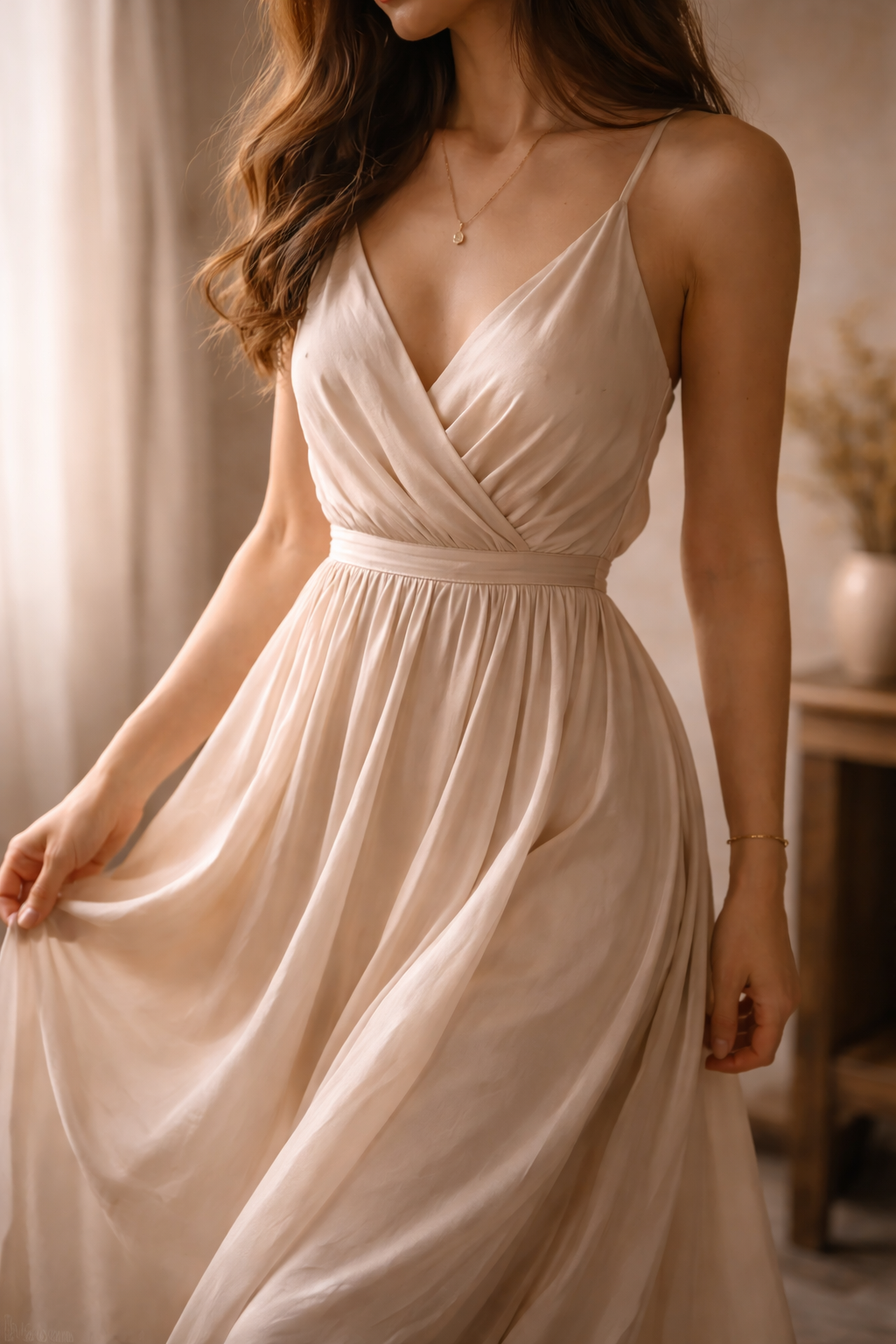
Preserving the Soul of What We Wear
Behind every garment that has survived time, there is a quiet intelligence—an inheritance of hands, of choices, of cultures that once understood fabric not as material, but as meaning. Long before clothing became disposable, it was deliberate. It carried identity, geography, ritual, and respect. A pattern was never just decoration. A stitch was never accidental. When people dressed up they were participating in a culture as like speaking a language— clothing is the one that speaks without words, yet it was ever understood across generations.
Why Fabric Echoes exists?
We want to bring that language back into awareness.
In the same way that great works of art are preserved by unseen experts who study, protect, and question every layer of their existence, textiles too hold histories that require interpretation. Yet unlike paintings behind museum glass, what we wear has been stripped of its reverence. We move through the world wrapped in materials we do not question, shaped by systems we do not see. When you try to understand this knowledge, you realize it has not disappeared—it has simply been buried beneath speed, convenience, and mass production.
And so a question emerges, one that mirrors the dilemmas faced in art conservation: do we restore what was, or do we preserve what remains?
This is not a technical question. It is a cultural one.
To restore is to recognize that something valuable has been lost—that craftsmanship, symbolism, and intentional design once held a place of importance in everyday life. To preserve is to acknowledge that even in its altered state, the present still carries traces of truth. Fabric Echoes stands at the intersection of these two realities, not to choose one over the other, but to illuminate both. Because awareness does not demand rejection—it demands understanding.
When we begin to look closely, textiles reveal themselves in layers. Much like hidden sketches beneath a painting, there are structures beneath what we wear—decisions about fiber, about form, about function. Natural materials once selected for their behavior, their resilience, their relationship to climate and body. Techniques passed down not through instruction manuals, but through practice, repetition, and trust in the material itself. There was a time when making something meant knowing it deeply.
That intimacy has been replaced.
Today, clothing is often approached as surface. It is chosen quickly, used briefly, and discarded without reflection. The connection between the wearer and the worn has weakened to the point where fabric is no longer experienced—it is simply consumed. And yet, beneath this shift, the original language has not disappeared. It waits, quietly, in the background, ready to be seen again by those willing to look.
Fabric Echoes is not about returning to the past. It is about restoring perception.
Asking what happens when we remove the layers that obscure our understanding—when we begin to question not only what something is made of, but why it was made that way. It reveals that materials are not interchangeable, that design is not neutral, and that what we choose to wear is never without consequence. In this realization, something shifts. What once seemed ordinary becomes precise. What once felt insignificant becomes intentional.
There is, within this shift, a moment of awakening.
Not loud, not forced—but undeniable.
It is the moment when a person recognizes that clothing is not separate from culture, nor from history, nor from the body itself. That what we wear carries memory—of land, of labor, of tradition, of innovation. That fabric is not passive. It responds, it ages, it interacts. It lives alongside us.
And once seen, it cannot be unseen.
Fabric Echoes is an invitation into that awareness. A space where textiles are not reduced to trend or function, but elevated into their full context—as artifacts, as expressions, as extensions of human thought and care. It is where craftsmanship is not nostalgic, but necessary. Where design is not decoration, but communication. Where fashion is not fast, but considered.
In a world that moves quickly, this perspective may feel unfamiliar at first. Even disruptive. But within that disruption lies clarity. A recognition that something essential has been overlooked—and that it can still be reclaimed.
Because fabric, like art, was never meant to be invisible.
It was meant to be understood.
If you are interested in Fabric Echoes work, contact us for more information.